

WHEN THE EVIDENCE LIES
What happens when surveillance no longer records reality…but rewrites it?

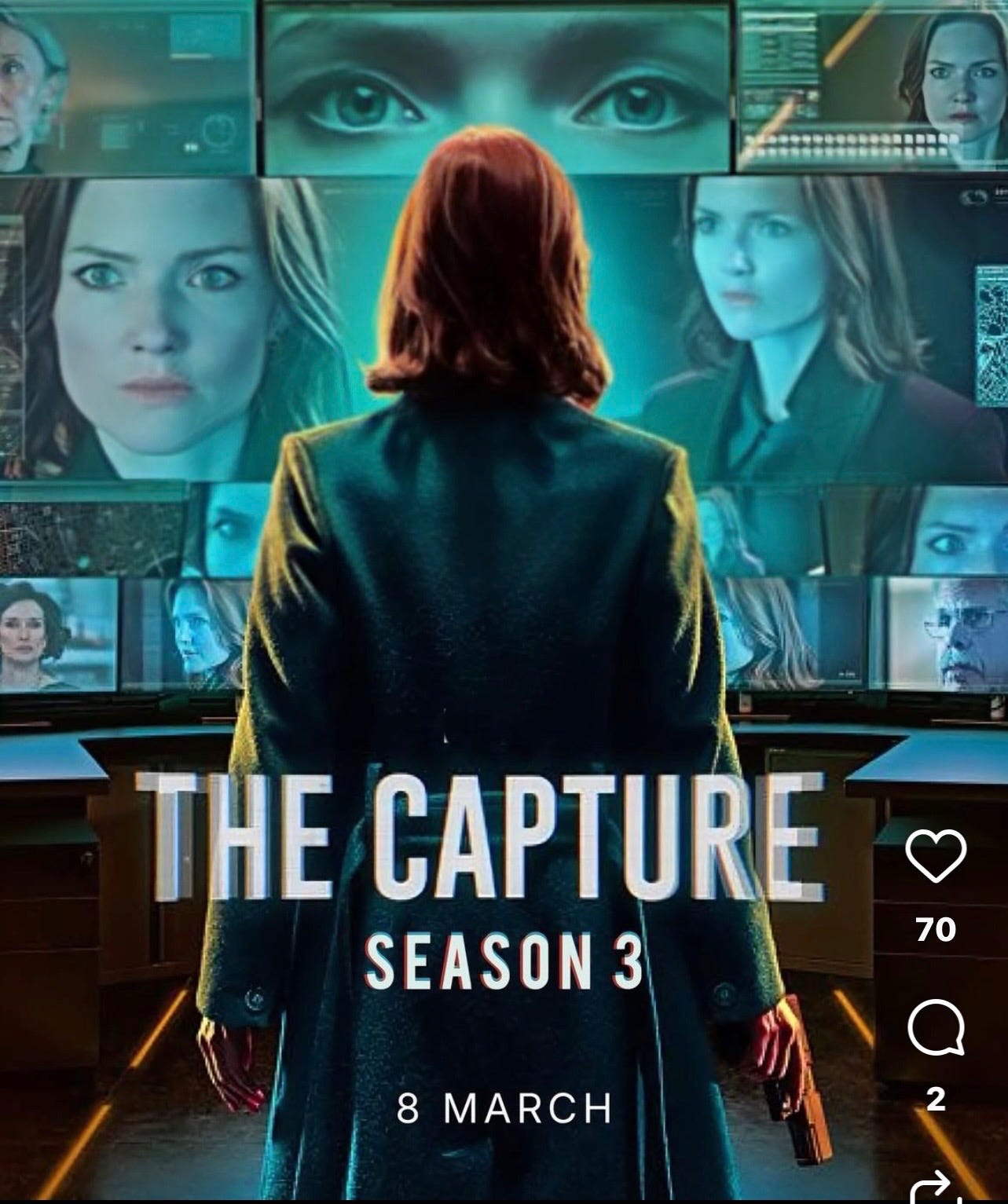
THE FIRST EPISODE of the BBC thriller The Capture hooked the Lone Wolf and me so hard that we binged all three seasons over a couple of weeks. It is crack TV, and not only because it’s a hell of a roller coaster. It feels less like fiction than prophecy, a warning to the world we’re now living in: one in which AI swallows reality, deepfakes destroy evidence, and surveillance systems track, sort, and predict our lives. Here’s the story:
The Capture is a British surveillance thriller about a former soldier, Shaun Emery, who is released after his conviction for murder in Afghanistan is overturned because of flawed video evidence. But almost immediately after he walks free, he is accused of another violent crime—and this time the evidence against him appears to be captured on CCTV.
Detective Rachel Carey, a fast-rising Detective Inspector in London’s Metropolitan Police, is assigned to what first appears to be an open-and-shut case, a straightforward crime caught on camera. But the more she looks, the less solid the evidence becomes. The show turns on a terrifying question: what happens when video—the thing we have been trained to trust as proof—can no longer be trusted?
It is not simply a show about surveillance. It is a show about power, narrative, evidence, and the terrifying possibility that reality itself can be edited by people with enough technology and authority.

Doesn’t this remind you of a company we know? It has the whiff of Palantir, which was established in 2003, long before this show’s 2019 debut. Palantir’s business is not simply “surveillance” in the old sense of someone watching a camera feed. It is data integration—pulling information from many sources (including social media when possible) into platforms that allow governments, police, intelligence agencies, militaries, and corporations to see patterns, make decisions, and act upon them. Its broader corporate pitch is real-time, AI-driven decision-making for “critical government and commercial enterprises,” while its “Gotham” platform is marketed for decision-making in dynamic operational environments like wars, which Palantir is quite proud of and markets aggressively. Think ICE, which has a contract with Palantir. So does Israel.
QUESTION: Did Israel use Gotham to target any or all of the 264 journalists and media workers they’ve killed (+ 174 injured and 107 imprisoned)? The Committee to Protect Journalists (CPJ) says Israel is engaging in the deadliest and most deliberate effort to kill and silence journalists that CPJ has ever documented. Palestinian journalists are being threatened, directly targeted, and murdered by Israeli forces, and are arbitrarily detained and tortured in retaliation for their work. Israel has systematically destroyed media infrastructure in Gaza, and tightened censorship throughout the West Bank and Israel. Inside Gaza, journalists report harassment and intimidation by Hamas.
And press-freedom groups have accused Israel of deliberate targeting.
George Orwell imagined Big Brother as a face on a screen. Gotham suggests something colder: Big Brother as infrastructure. Gotham is Big Brother militarized. In Israel’s war machine, Palantir’s software is not just watching; it is helping organize the information by which targets are identified, prioritized, and acted upon. That’s the terrifying leap from surveillance to prediction to execution.

On Palantir’s website about Gotham: “Powering the Kill chain,” (a kill chain being a military concept which identifies the structure of an attack, and includes its outcome: Gotham’s targeting offering supports soldiers with an Al-powered kill chain, seamlessly and responsibly integrating target identification and target effector pairing. Operators experience enhanced situational awareness and effectiveness as Gotham streamlines critical decision-making in the modern battlespace.
I’m always keeping an eye out about what Palantir is doing, because, frankly, I don’t trust the surveillance Palantir is up to, especially with what we’ve seen happening with ICE. I don’t trust Christian nationalist, Trump-enabler Peter Thiel or Palantir’s CEO Alex Karp. For a little insight about Karp, here’s a quote from New York magazine: And then there is Alex Karp, Palantir’s CEO, who has leaned into Palantir’s notoriety. “The only way” to save the West and stop war, he told Fast Company, is to “scare the daylights out of our adversaries.” During a talk last year, Karp fantasized about deploying a drone to spray “fentanyl-laced urine” on analysts who had criticized the firm’s valuation; the company recently sold T-shirts reading “There Are No Secrets.”
And you remember Karp’s bizarre performance during an interview at the New York Times DealBook Summit in early December 2025. Here’s another clip of it in which Karp is defending Trump. You might not have seen this video of him talking about Palantir’s Q4 Earnings Call.
A brief note: While not every American is under constant, active watch, all Americans are subject to extensive, systemic, and often passive data collection by government agencies and private corporations—essentially a pervasive surveillance environment. This is a subject that would take one or more columns to address, which I will get to in the future. Also, since DOGE took our private information, we don’t truly know who has our information and how they’re using it. I include Palantir.
A few Palantir updates:
1. On March 30, WIRED published an article on Palantir and the IRS. Documents show the tax agency is testing a Palantir tool to surface “highest-value” audit and investigation targets from a maze of legacy systems. … In total, Palantir has been awarded more than $200 million in contracts and obligated payments with the IRS. The documents show the agency is now interested in deepening its relationship with Palantir.
The Intercept has a more extensive article about Palantir and the IRS: PALANTIR IS HELPING TRUMP’S IRS CONDUCT “MASSIVE-SCALE” DATA MINING. If you’re interested in this subject, it’s worth your time to read. From The Intercept: “The real concern is the consolidation of vast amounts of sensitive personal data into a single system with minimal transparency—especially one built and operated by a contractor like Palantir, whose business model is premised on integrating data and expanding surveillance capabilities,” American Oversight director Chioma Chukwu said in a statement to The Intercept. “Its platforms have been used in deeply troubling contexts, from immigration enforcement to predictive policing, with persistent concerns about overreach, bias, and weak oversight.”
2. As Francesca Bria argued in Le Monde Diplomatique last November, the danger is not simply that companies like Palantir and Anduril (another Peter Thiel-backed company/he is Anduril’s foundational financial backer and strategic architect since its inception) sell tools to the government. It is that core functions of the state—data analysis, military planning, battlefield surveillance, targeting infrastructure, and operational decision-making—are being absorbed into private technological systems. In July 2025, the U.S. Army announced a sweeping enterprise agreement with Palantir worth up to $10 billion over ten years, consolidating dozens of contracts into a single framework for the Army’s future software and data needs. That is not science fiction. That is the privatization of state power.
3. Palantir Technologies’ private think tank recently co-hosted an unpublicized conference at Yale University as reported by New York. The event brought together Palantir executives, intelligence community veterans, and Trump administration officials to outline a vision integrating artificial intelligence with state power. Speakers strongly rejected government AI regulations, instead advocating for radical public-private partnerships and legal theories like using the Defense Production Act to bypass local authority for national data center construction. The conference highlighted Palantir’s massive profit growth from federal surveillance and military contracts—such as Immigration OS for ICE and Project Maven for the Pentagon—while demonstrating how high-paying defense tech roles continue to attract Ivy League students despite campus-wide ethical pushback.
If you’re not worried about this, you should be. Palantir is supplying the technology for 21st Century authoritarianism. Once you see The Capture, you’ll see an AI-imagined future that is already in play. On April 23, WIRED posted an article with the title “Palantir Employees Are Starting to Wonder if They’re the Bad Guys.” My question is, why do they even have to ask? But from what I’ve read, their company culture is steeped in what I’m going to call “mythical indoctrination.” Remember, all of Peter Theil’s companies echo Lord Of The Rings lore—the Palantir employees are called “hobbits,” and their offices or alumni network is “the Shire.” In fact, global executives have posted recruitment calls on social media explicitly pleading for “former hobbits” to return because “the Shire is calling.”
The problem is that Thiel doesn’t want to be the protective wizard Gandalf. His public commentary and ideological views reveal that he aligns himself with the forces of Mordor and Sauron, actively viewing the traditional “villains” as the rational, technologically advanced heroes of the story. This is totally revealing about Thiel, his companies, and Karp, who is publicly in-like-flint with Thiel and the Shire.
***
THE CAPTURE WAS created by British writer-director Ben Chanan, whose background in documentary and counterterrorism research gave the series its terrifying plausibility. He understood, before much of the public did, that the central evidence of the modern surveillance state—the video image—was about to become unstable. Chanan was not just dreaming up some random techno-thriller. The idea reportedly grew out of his interest in how vital video evidence had become to modern prosecutions…right at the moment when digital technology was making video easier to manipulate. It’s a truly unnerving premise: We built a criminal-justice and security culture around the idea that recorded images are proof, and then technology undermined our trust.
But it’s more than that. Chanan captured the power of how AI and deepfake technologies were going to entangle all of us in ways we had barely begun to consider. He shows how hard it’s going to be to hold on to our independence, and how vigilant we’ll have to be to not succumb to powers that seem impossible to defeat—powers like Palantir, private companies whose software is increasingly embedded in the machinery of governments, militaries, police agencies, intelligence services, immigration enforcement, and corporations around the world.
Thiel has traveled to San Francisco, Paris, and Rome giving lectures on ‘the Antichrist,’ warning that a global authoritarian order will seize power by promising to save humanity from catastrophes like climate change, nuclear war, and AI—and then using that fear to stop technological progress. The profound irony, as noted by critics and Vatican advisers, is that Thiel himself is building a corporate authoritarian infrastructure. As a central figure of the anti-democratic Dark Enlightenment, his ultimate goal is a world where he and his fellow Tech Bros are unaccountable, and their surveillance empires operate completely unchecked by democratic rules.
***
NOW WE COME to predictive policing. An early, rudimentary form of predictive analytics was first used in Richmond, Virginia, in 2003. The Richmond Police Department successfully predicted the timing, nature, and specific locations of future incidents of shots being fired, resulting in a massive drop in gunfire and a major increase in weapons seized. Santa Cruz tried it in 2011 with software called PredPol, as did Los Angeles. LA then started its highly controversial person-based tracking initiative, Operation LASER. The LAPD paid over $20 million to Palantir Technologies, whose data-mining platform was used to generate ‘Chronic Offender Bulletins’ that targeted and surveilled specific individuals. New Orleans and New York City began predictive policing with Palantir in 2012.
When the movie Minority Report, with Tom Cruise, Samantha Morton, and Colin Farrell, dropped into our consciousness in 2002, this sci-fi story from Philip K. Dick riveted us. Based on technological predictions, Minority Report’s predictive policing arrested people for crimes they hadn’t yet committed. These forecasts came through three mutated humans called “Precogs,” who possessed psychic abilities to see future murders before they happened. Giving it the human element of these strange, abused (?) psychics who were submerged in water where they floated for their divinations, is of course more interesting than the coldness of technology.
Tom Cruise plays the lead role of the commanding officer John Anderton of Washington D.C.’s experimental “Precrime” law enforcement division. He is fiercely dedicated to Precrime because his young son was kidnapped and murdered years prior. He genuinely believes that preventing crimes before they happen is the only way to save families from his pain. The plot hinges on a massive twist: The Precogs suddenly generate a new prediction showing that, in exactly 36 hours, Anderton himself will murder a man he has never met. And away we go. The point is, this is a state that could punish you for what it believed you were going to do.
Spoiler: The Capture imagines something even more modern: a state that can manufacture the record of what it wants the world to believe you have already done. The genius of the first episode is that it gives us the comfort of righteousness. A man is on trial. Video evidence is challenged. A bad conviction is overturned, and the justice system seems to work. An innocent man goes free.
And then, almost immediately, the show yanks that comfort away and asks the question we are now being forced to ask in real life: If images can be manipulated, if cameras can be hacked, if official evidence can be “corrected,” then what exactly is proof?
AI can be manipulated. Is anyone safe?
Thank you for reading FROM THE INSIDE OUT.
Pieces like this are made possible by the readers and listeners who support this newsletter. I write here because I believe we have to keep naming what is happening while it is happening — especially when the machinery of power is moving faster than the public’s ability to see it clearly.
If this piece gave you something to think about, please consider becoming a paid subscriber. Free subscriptions matter, too. Every reader helps this work travel farther, and every paid subscription helps sustain the time, research, and independence it takes to keep doing it.
Please share this piece with someone who is paying attention — or someone who needs to be.
And I’d love to hear from you in the comments: What do you think happens to justice, democracy, and ordinary human freedom when evidence itself can be manipulated?
SURPRISE ENDING…
Thanks both for the recommendation of this series, and for your astute assessment. It's a cold and rainy day today, so I think I know what I'll be doing from here on out!
But, yes, the existential threat this administration has unleashed on us, innocent, unassuming, non-threatening American citizens, makes these fictional over-the-top crime dramas seem not so much believable, as actual documentaries of our lived experience. It's abominable, deplorable, and horrifying, and the psycho-emotional toll, not to mention the physical toll, it's taking on us will be the study of social scientists for generations. Remaining emotionally regulated these days is a full-time, unrelenting, unforgiving job.