

THE NEW LOST GENERATION?

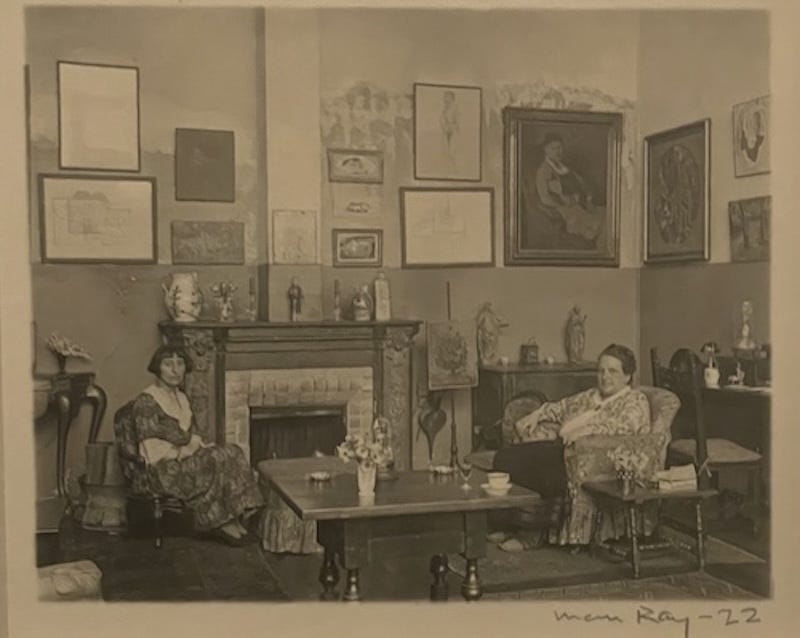
Man Ray: Alice B. Toklas and Gertrude Stein, 1922, Gelatin silver print Image
LAST WEEK, I read an article in Le Monde titled “Is America still a dream destination for French artists?” And I thought, How could it be? Why would anyone from any other country want to come here, even for a vacation, when they might be turned away at the border, roughed up by masked ICE storm troopers, or even thrown into one of our new immigrant detention gulags?
The United States now looks and acts like a Fascist country. In fact, according to the experts on Fascism that I read, we are Fascists now. Watching what some people—including Robert Reich—call a demented Trump send troops into American cities is too reminiscent of Gestapo jackboots invading countries throughout Europe in the 1930s. And that unhinged speech at the U.N.? It was The Man in the High Castle meets The Twilight Zone.
It’s apparent that the unholy alliance of Trump, the Christian nationalists, and the Tech Bros are using the authoritarian playbook to shut down freedom of speech, as well as to roll over anything or anybody who gets in their way. Trump’s Revenge Tour to destroy his enemies with his DOJ personal fleet of attorneys is just getting started. While the Democrats are trying to claw back some of the health and food benefits the American public sorely needs in the government shutdown, demonic Russell Vought is punishing Democratic cities and I’m reading he’s next going after “the Democrat Agencies, most of which are a political SCAM” as Trump said. I’m a native-born American, and even I don’t feel safe here.
As for foreigners on U.S. soil, Trump is making them our enemies. Look what happened to the South Koreans in Georgia who were working on the Hyundai and LG Energy Solution electric vehicle battery plant, an enormous investment that would bring 8,500 jobs to the state of Georgia. They thought they were the kind of highly skilled engineers who could help fulfill President Trump’s goal of reviving American manufacturing. Instead, they were shackled and detained for a week in bad conditions, before fortunately being sent home. Angry and afraid, they said America is not a safe place to work.
We particularly have Stephen Miller to thank for this. Miller has made it his mission to destroy the immigrant spirit, put them in shackles like criminals, then throw them out of here to countries where they don’t even belong. The irony is that Stephen Miller’s Jewish family escaped Nazi Germany and immigrated to the United States, where he grew up in Santa Monica, California. Where the heck did he learn all that hate?
This is what the Southern Poverty Law Center says about him: Stephen Miller is credited with shaping the racist and draconian immigration policies of President Trump, which include the zero-tolerance policy, also known as family separation, the Muslim ban and ending the Deferred Action for Childhood Arrivals (DACA) program. Miller has also “purged” government agencies of civil servants who are not entirely loyal to his extremist agenda, according to a report in Vanity Fair.
If Donald Trump is having one of his bad days, will any foreigner—papers or not—be safe here?
EVEN MANY AMERICANS don’t want to be in the U.S. now. I have friends who are moving to Barcelona, and others who’ve created an escape to Italy. I personally am feeling homesick for France, where I lived for 10 years. I can’t imagine any French artists wanting to come to the U.S. in this political and cultural atmosphere.
It was because of art, and the French reverence for artists, that I wanted to live in France in the first place. Almost every French village has some sort of museum. French children are immersed in art as an important part of their culture. But here in the United States, we generally could care less about arts of any kind. When classes are cut in our schools, it’s the arts that are the first to go. They’re not considered important to what really matters to Americans.
I recently wrote about Robert Redford, who grew up playing sports, and he was good enough to earn a baseball scholarship for college. But what he really wanted to do in life was to be an artist—a painter. As we all know, while he continued to paint on his own, he turned out to be a master of the art of filmmaking. And in an interview with him that I watched, he alluded to a falsity in the way many American kids are brought up. They’re fed the old sports canard, “It’s not whether you win or lose—it’s how you play the game that counts.” And what Redford said is…that’s a lie.
I was interested to hear him say that, because I’ve talked about this cultural trouble for years. I didn’t grow up playing sports as Redford did, but I watched it with my friends and their kids, especially boys. And what I myself have understood, through the undercurrents of our society, is that the values our American children are actually raised with is this: If you win, you’re a winner. You’re a loser if you lose. And that’s it. No learning through failing. No life is a journey, and different experiences are valuable—which are all cosmically true concepts and lead to happier lives. But in this country, it’s a dog-eat-dog world. And Donald Trump is the perfect example of one of our worst underlying convictions, one that plays out to our societal detriment: Happiness isn’t just about how much money you have. Data shows that’s a lie, too.
One hundred years ago, after WWI—better known then as The Great War—artists were crossing the Atlantic in the other direction. This generation of young Americans had survived the supposed “War to End All Wars,” when machine guns, tanks, and poison gas were used for the first time, while people were also wiped out by starvation and disease. The overall results were 9.7 million military deaths and 6.8 million civilian deaths, totaling around 16.5 million fatalities. The world had never seen anything like it.

Ernest and Pauline Hemingway, 1927
After the global trauma of the war, young men and women left the United States for Paris because it was cheaper, and they could pursue their artistic ambitions. The U.S. felt materialistic and conservative, while the cultural scene in Paris was vibrant. There was a sense of liberation and energy that didn’t exist in the stagnant United States. Paris was the center of the avant-garde, and artists and intellectuals came from around the world to “live as though they were about to die,” which was one of Hemingway’s great themes. A Parisian Bohemian world of poets, painters, and writers captured the imagination of the creative set in both the United States and Europe, and they flocked there to become who they wanted to be.
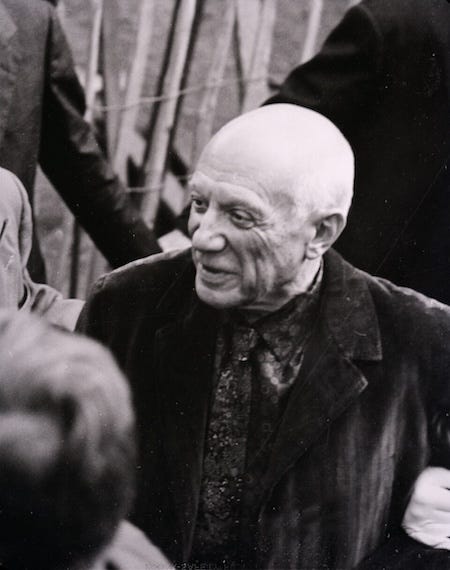
Picasso photographed in 1953 by Paolo Monti during an exhibition at Palazzo Reale in Milan (Fondo Paolo Monti, BEIC)
I, like so many others, have been fascinated by The Lost Generation of writers like Ernest Hemingway, F. Scott Fitzgerald, T.S. Eliot, John Dos Passos, and Gertrude Stein. When my husband and I lived in Paris, I devised missions for our morning walks, to find the houses, apartments, and villas where these now-famous writers and artists lived and worked. It brought me joy to stand before them, to get as much of a sense of their lives as I could soak up. Ms. Stein held a famous salon, where all the painters, including Pablo Picasso and Henri Matisse, gathered. I’ve been in that house. Stein’s entire family collected the paintings of those young artists who are considered masters today, and I’ve seen her family’s stunning collection of art. During our time in the 20th Arrondissement, around the corner from Pére Lachaise Cemetery, we visited, almost daily, the joint burial place of Gertrude Stein and Alice B. Toklas. Ms. Stein’s name is engraved on one side of the stone and Ms. Toklas’ on the other.
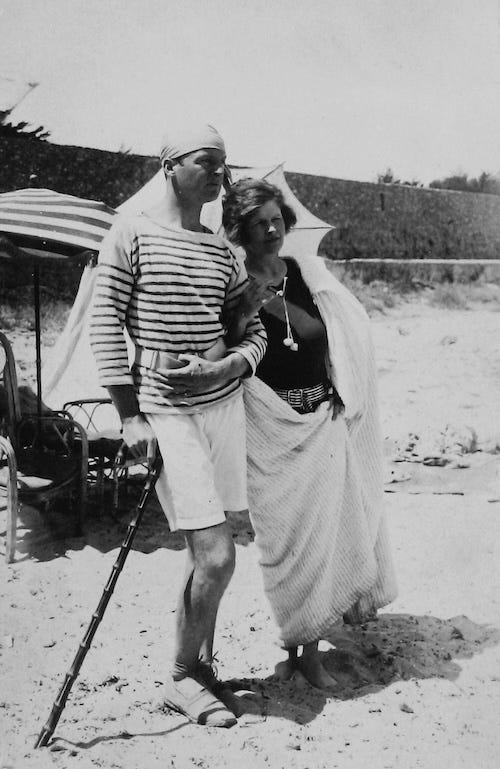
Gerald and Sara Murphy at Cap d’Antibes beach, 1923
Two of my favorite artists in The Lost Generation were masters of the art of living beautiful lives. Sara and Gerald Murphy were elegance personified, and their personal style was exquisite. They knew all the most interesting people, and they created their personal spaces with beauty and wonderful design. They basically invented summering on the French Riviera, and Gerald, a painter, created the classic summer look of wearing the Breton striped T-shirt that even Coco Chanel adopted. The Murphys also suffered great tragedy in the death of both of their sons as children. The most wonderful book about them, Living Well Is the Best Revenge by Calvin Tomkins, is a book I always kept on my desk. “Those closest to the Murphys found it almost impossible to describe the special quality of their life,” Tomkins wrote, “or the charm it had for their friends…They were utterly captivating.”
BUT BACK TO that piece in Le Monde, which was basically about artists coming here for the business—the commerce—of enhancing their artistic careers.
For a long time, exhibiting in the United States was the ultimate goal for artists – both a rite of passage and a springboard to international recognition. But since Donald Trump’s election, as he has moved to silence progressive voices in museums, universities and the media, that American dream has sprung a leak. The country now fascinates less and worries more. So much so that, in April, Rolling Stone magazine bluntly asked: “Is there a tipping point where the US stops being worth it for international acts?”
Some of the international musicians who cancelled tours in the U.S. due to Trump are German violinist Christian Tetzlaff and Canadian Bells Larsen. Bad Bunny left the U.S. out of his world tour because of his worry about immigration raids at his concerts. But now he’s booked to perform at Super Bowl LX, where, as a little payback, he’ll perform only in Spanish.
What the Le Monde article points out, however, is that presidents come and go, and the French—as well as others—want to continue their positive relationships with the U.S. Our country and France have had diplomatic relations for coming up on 250 years; in fact, The United States of America would not exist without France. French money, French supplies, French troops, and French naval power were crucial in our securing our independence. The French spent so much of their resources on our revolution that it became a significant contributing factor to theirs.
On the eve of next year’s historic anniversary, the French art world is embracing American artists.
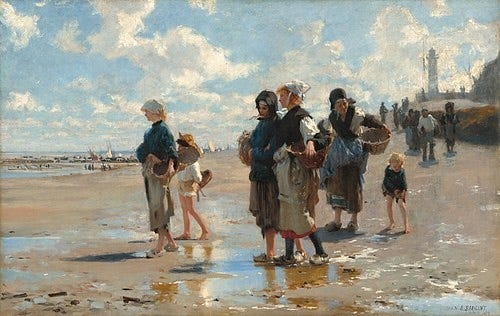
John Singer Sargent, The Cancale Oyster Gatherers (on their way to fishing), Corcoran Collection
Now is not the time for reproaches but for celebrations, getting a head start on marking 250 years of diplomatic relations between France and the US. This fall, the best of American art – including its most radical creators – is making a splash in Parisian museums. The Musée d’Orsay is honoring painter John Singer Sargent (1856-1925), while the Palais de Tokyo is celebrating the transatlantic exchange of Francophone ideas. The Musée National Picasso-Paris, for its part, is shining a spotlight on painter Philip Guston (1913-1980), a well-known anti-racist and Marxist sympathizer. The symbolism is impossible to ignore. “It’s a subliminal way of showing Americans how much their culture of radicalism has nourished all of us,” acknowledged Debray, recalling how the ties between Paris and New York have always been “visceral.”
That said, Paris’ Lost Generation of the 1920s retains a mystique that this generation of artists coming here from France are not looking for. This is business, pure and simple. Imagine coming to the U.S. now to reinvent yourself?
As much as I love/d Paris—and it is my home whether I live there or not—at the end of my time there, I didn’t feel the passionate energy that sparkled through Paris in its celebrated ‘20’s artistic realm of art, journalism, and literature and that effervesced through the galleries, restaurants, and lofts of New York in the 80’s. In the early 2000’s, the avant-garde was erupting in Berlin, and that’s where the French traveled to find it. When I hopped over to London, art fever electrified the air. The zeitgeist changes from time to time and from place to place.
The world goes to France to experience its gorgeous culture. Its charm doesn’t change, and we’re drawn to it like moths to a flame. But as much as the French like to think of themselves as revolutionaries, their society is set up to be rigid, their bureaucracy more difficult than ours. The fact that it is so hard to change the centuries-old culture that we so adore and the status quo means that dynamic growth is slowed way down, and it can become stilted in the face of cutting-edge modernity.
But if there’s one thing that’s true in life, it is that things will change. People will change. Governments will change. Worlds will change, and evolution is part of the rhythm of life wherever you are.
I was glad to read in this piece that “The US still captures the imagination.” And I was very happy to read that one French artist living in the U.S. thought our cultural openness to allow one to reinvent himself was intact, even if artists like him—and like everyone else here—is standing strong but scared. Reinventing yourself is the American dream in a nutshell, and it is what we also proudly offered in welcoming immigrants. But as Heather Cox Richardson pointed out in her October 1st newsletter even American citizens are being profiled, arrested, and detained every day. Military-like raids in Chicago look more and more as though our president has declared war on his own people and his own cities and that an American Gestapo has been launched. As AP reported: Storming an apartment complex by helicopter as families slept. Deploying chemical agents near a public school. Handcuffing a Chicago City Council member at a hospital.
I wish these French artists and researchers all the best in coming here. I believe the American people will open their arms and their hearts to them. I just hope they are treated well and with respect by our government.
Please send any questions or comments, so our community can address and respond to them.
Peace. 🕊️ 🕊️🕊️ We are one.
I so appreciate your reading A Liberal Southern Woman. I am an independent creator, and your financial and social support are truly essential to me so I can do this work. If you enjoy my pieces, I hope you’ll subscribe and pass A Liberal Southern Woman along to your people. And if you’ll take a moment to “Heart” and Restack my posts, that would also give me feedback and a little a bump. I’d love to hear from you! Please comment. Also, if possible, please consider becoming a Paid Subscriber. Every bit of your backing counts. It makes a difference. And please help me spread the word by sharing my newsletters and site with family and friends. Thank you ever so for all of the above! I am grateful.
Love, Beth 💖🙏🏻💋

P.S. And please take care of yourselves. Spend time keeping up your spirits, and don’t give up. Find ways to nurture yourselves with inspiration and hope. As Martin Luther King said, “Darkness cannot drive out darkness; only light can do that. Hate cannot drive out hate; only love can do that.” Sending love now…🩵💙🩵 We shall overcome.
SECRET ENDING…
Excellent article Beth! I love the comparison of today to "The Man in the High Castle" meets "The Twilight Zone". The current US state of affairs feels upside down to me.
I also appreciate the post WWI analysis in reference to the arts and The Lost Generation. I especially love Hemingway's, "A Farewell to Arms", as it relates to this period. I too hope that the US doesn't lose the allure for artists that it has had for some time. I'm afraid there has been a chilling effect for some artists such as "Bad Bunny", as you mentioned. I certainly hope that ICE doesn't raid the Super Bowl, but I won't be surprised if there is heavy presence in the surrounding area.
I hope daily for things to get better here.